
Hex Rivet Nut Hole Size Chart
During the riveting process, hole size accuracy is a crucial factor determining the assembly quality and structural reliability. For hex rivet nuts, the correct hole diameter not only affects the smoothness of installation. It also directly relates to the anti-rotation performance, pulling force, and overall service life. Therefore, when referring to the Hex Rivet Nut Hole Size Chart, engineers should strictly adhere to the recommended drilling size range and make a comprehensive judgment based on the material hardness, nut specifications, and installation method.
What Is a Hex Rivet Nut and How Does It Work?
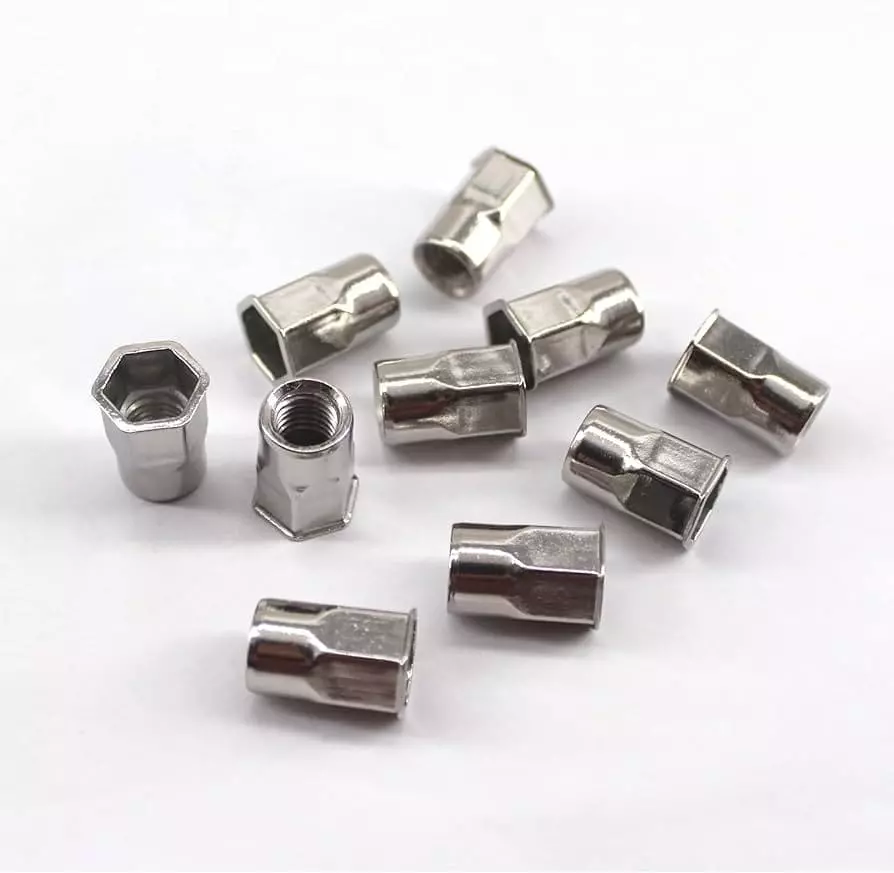
The hex rivet nut is a metal fastener used in thin plates or hollow structures. It is installed using a special rivet nut gun, creating a reliable connection point with internal threads in thin-walled materials. During installation, the body of the nut is stretched and deformed, causing the rear end to form a flange on the back of the plate, thereby achieving a secure lock.
Compared with the traditional round rivet nuts, the greatest advantage of hexagonal rivet nuts lies in their stronger anti-rotation capability. Their shape is a hexagonal structure, which can closely fit the corresponding hexagonal holes, effectively preventing slippage or rotation when tightening or disassembling the bolts. They are suitable for use in environments with vibration or repeated assembly and disassembly.
In addition, the hexagonal rivet nut is suitable for a variety of materials, including steel, aluminum, stainless steel, etc. It can achieve stable threaded connections on thin plates with a thickness ranging from 0.5 mm to 6 mm, and also possesses high tensile strength and torsional performance.
Metric Hex Rivet Nut Hole Size Chart (M3–M12)
| Thread Size | Hole Diameter (Across Flat, mm) | Recommended Drill Bit (mm) | Grip Range (mm) | Hex Flats (mm) |
|---|---|---|---|---|
| M3 | 5.6 | 5.5 | 0.5–1.5 | 5.5 ± 0.05 |
| M4 | 6.8 | 6.9 | 0.5–2.0 | 6.8 ± 0.05 |
| M5 | 7.9 | 8.0 | 0.5–3.0 | 7.9 ± 0.05 |
| M6 | 9.1 | 9.2 | 0.8–3.5 | 9.1 ± 0.05 |
| M8 | 11.1 | 11.2 | 1.0–4.0 | 11.1 ± 0.05 |
| M10 | 13.5 | 13.6 | 1.5–5.0 | 13.5 ± 0.05 |
| M12 | 16.5 | 16.7 | 2.0–6.0 | 16.5 ± 0.05 |
- The across flat, or the dimension of the hexagon’s opposite sides, should be ensured to have a machining accuracy within ±0.05mm.
- It is recommended to use punching or laser cutting processes, to avoid excessive chamfering which may cause loose fit.
- For high-load vibration structures, the Rivmate HX series anti-rotation hexagonal rivet nuts can be selected, used in conjunction with hexagonal punched holes, which can increase the anti-rotation force by 50–80%.
Inch Hex Rivet Nut Hole Size Chart (#6–1/2”)
| Thread Size | Hole Diameter (Across Flat, inch) | Recommended Drill Bit (inch) | Grip Range (inch) | Hex Flats (inch) |
|---|---|---|---|---|
| #6-32 | 0.250 | 0.257 (F) | 0.020–0.080 | 0.250 ± 0.002 |
| #8-32 | 0.281 | 0.281 (I) | 0.020–0.100 | 0.281 ± 0.002 |
| #10-24 / #10-32 | 0.312 | 0.313 (J) | 0.020–0.120 | 0.312 ± 0.002 |
| 1/4”-20 / 1/4”-28 | 0.375 | 0.376 (U) | 0.030–0.150 | 0.375 ± 0.002 |
| 5/16”-18 / 5/16”-24 | 0.437 | 0.438 (7/16) | 0.030–0.180 | 0.437 ± 0.002 |
| 3/8”-16 / 3/8”-24 | 0.500 | 0.501 (1/2) | 0.040–0.200 | 0.500 ± 0.002 |
| 1/2”-13 | 0.688 | 0.689 (11/16) | 0.060–0.250 | 0.688 ± 0.002 |
- The imperial drill bit size follows the ANSI B94.11M standard; the hole diameter accuracy is recommended to be controlled within ±0.002″.
- For structural steel or hard alloy substrates, the hole diameter can be appropriately relaxed by +0.05mm / +0.002″.
- If used in anti-corrosion or electrical environments, it is recommended to use stainless steel or galvanized hexagonal rivet nuts.
Data Verification
All values in this Hex Rivet Nut Hole Size Chart are verified by Rivmate Engineering Lab,
certified to ISO 9001:2015 Quality Management System and ISO 14589:2020 Performance Standard.
Have more questions?
Contact us for technical support, advice and quotes.
How to Select the Right Hole Size – Engineering Considerations
The correct hole size not only ensures that the rivet nut can be smoothly inserted and locked, but also prevents excessive assembly force or anti-rotation failure.
1️⃣ Material Thickness
The thicker the sheet material is, the more fully the rivets are formed, and the higher the tolerance for the size of the hole diameter.
For thin plates (≤1.0mm), the hole diameter must be strictly controlled to prevent the rivet body from deforming or the retaining ring from being incomplete. Rivmate suggests: The hole diameter deviation for thin plates should not exceed ±0.05mm.
2️⃣ Base Material Hardness
Different materials have different requirements for the aperture:
- Soft aluminum sheet or plastic substrate → It is recommended to choose a slightly smaller hole diameter (about 0.05mm smaller than the standard value) to increase friction and anti-torsion force.
- Steel plate or stainless steel substrate → It is recommended to maintain the standard hole diameter to avoid assembly difficulties or damage to the rivet body. In high-hardness materials, Rivmate recommends using toothed or hexagonal anti-loosening structures to enhance mechanical interlocking.
- Aluminum rivet nuts: Have significant expansion deformation, so sufficient clearance should be maintained;
- Steel or stainless steel nuts: Require high installation accuracy. It is recommended to make the hole diameter slightly tight to reduce the risk of rotation.
If different metal combinations are used, the risk of electrochemical corrosion should be considered and a reasonable gap should be maintained.
4️⃣ Anti-Rotation Requirement
The anti-loosening effect of the hexagonal rivet nut depends on the accuracy of the hole shape. If the hole angle is too rounded or there are surface burrs, it will lead to failure of sliding. In production, the hexagonal holes should be processed using the shearing or laser cutting process, and the burrs should be removed before assembly.
Rivetfix suggests using CNC die-cutting to control the edge size error within ±0.05mm to achieve the best anti-torsion performance.
Why Do Hex Rivet Nuts Require Special Hole Shapes?
During the structural design stage, rational planning of hole spacing, edge distance and plate thickness matching is a crucial step to ensure the long-term reliable connection of hex rivet nuts.
① Recommend Minimum Edge Distance
Edge distance refers to the minimum distance from the center of the Rivnut hole to the edge of the plate. If the edge distance is insufficient, the radial expansion force generated during riveting will cause the edge of the plate to warp or crack.
If the sheet is very thin (≤ 1.0mm), additional reinforcing ribs or embossing should be added to the edge area to distribute the riveting stress.
| Thread Size | Recommended Edge Distance (mm) | Engineering Notes |
|---|---|---|
| M3 | ≥ 6.0 | Suitable for light-load structures or compact assemblies |
| M4 | ≥ 8.0 | Commonly used in equipment housings and control panels |
| M5 | ≥ 10.0 | Effectively prevents edge distortion or warping |
| M6 | ≥ 12.0 | Maintain larger margins in areas with stress concentration |
| M8 | ≥ 15.0 | Ideal for high-load applications such as chassis and brackets |
| M10+ | ≥ 18.0 | Reinforcement ribs or backing plates recommended if edge distance is limited |
② Recommended Pitch Distance
The pitch distance refers to the minimum distance between the centers of two rivet nuts. If the distance is too close, the plastic zones of adjacent rivets will overlap, resulting in reduced clamping force and structural strength.
If a dense layout is required, small-head or thin-walled hexagonal rivet nuts should be used first, and the spacing should be verified through a pull riveting test to ensure its rationality.
| Thread Size | Recommended Pitch (mm) | Notes |
|---|---|---|
| M3 | ≥ 10.0 | Maintain sufficient spacing to prevent rivet flange interference |
| M4 | ≥ 12.0 | Can be slightly reduced for light-load connections |
| M5 | ≥ 15.0 | Standard spacing commonly used in industrial equipment |
| M6 | ≥ 18.0 | Recommended for automotive structural assemblies |
| M8 | ≥ 22.0 | Prevents stress overlap and panel warping |
| M10 | ≥ 26.0 | Larger rivet nuts require wider spacing for structural stability |
③ Grip Range Matching
Selecting the appropriate grip range is the foundation for ensuring the correct formation of Rivnut. If the plate thickness exceeds the grip range, the rivet ring cannot fully expand; if it is too thin, it is prone to being pulled through or forming a false connection.
Summary:
| Thread Size | Recommended Grip Range (mm) | Typical Base Thickness (mm) |
|---|---|---|
| M3 | 0.5–1.5 | 0.6–1.0 |
| M4 | 0.5–2.0 | 0.8–1.5 |
| M5 | 0.5–3.0 | 1.0–2.0 |
| M6 | 0.8–3.5 | 1.2–2.5 |
| M8 | 1.0–4.0 | 1.5–3.0 |
| M10 | 1.5–5.0 | 2.0–4.0 |
| M12 | 2.0–6.0 | 2.5–5.0 |
- The thickness of the plate should be located in the middle section of the recommended clamping range to ensure uniform forming.
- If there are multiple layers of plates assembled, the total thickness should be calculated together and the clamping allowance should be verified to be ≥ 0.2mm.
- For critical structures, it is recommended to conduct sample riveting tests (Pull Test) to confirm the performance.
FAQs
Temperature variations will significantly affect the assembly accuracy, material deformation and locking stability of hex rivet nuts.
In a high-temperature environment (>80°C), metal materials will undergo thermal expansion, causing the hole diameter to slightly increase, resulting in a decrease in the anti-loosening force; while in a low-temperature condition (<0°C), the material contracts, and during riveting, there is a tendency for the retaining ring to be incomplete or the rivet body to crack.
Rivetfix engineering test indicates:
- When the temperature fluctuates by ±40°C, the aperture deviation can reach 0.03–0.05mm, which is sufficient to affect the anti-torsion force;
- The thermal expansion of the aluminum substrate has a significant impact, and it should be assembled at room temperature first;
- Steel or stainless steel substrates are more stable, but the temperature difference during riveting still needs to be controlled within ±10°C.
Q2. What Are Common Signs of Improper Hex Hole Size?
Great question—improper hex hole size can significantly impact the performance and reliability of rivet nuts or other fasteners. Here are common signs that a hex hole size is incorrect (either too small or too large):
Signs the Hex Hole is Too Small:
- Difficulty Inserting the Rivet Nut
- Excessive force is required, or insertion is not possible without damaging the fastener or workpiece.
- Distortion of the Workpiece
- The material around the hole bends or deforms during installation.
- Improper Seating of the Rivet Nut
- The flange may not sit flush with the surface, affecting clamping force and appearance.
- Tool Jamming or Damage
- Installation tools may jam, stall, or suffer undue wear due to excess resistance.
Signs the Hex Hole is Too Large:
- Rivet Nut Spins in the Hole (Spin-Out)
- During installation or use, the nut fails to lock in place and rotates freely.
- Reduced Torque Resistance
- The fastened joint loosens under vibration or dynamic load.
- Misalignment or Tilted Fastener
- The rivet nut doesn’t sit squarely in the hole, leading to uneven load distribution.
- Cracked or Split Workpiece
- Lack of proper support may lead to cracks, especially in brittle materials.
- Pull-Out Failure
- The rivet nut pulls through the material under load due to insufficient grip.
Q3. Can Custom Hole Sizes Be Manufactured for Specialized Hex Rivet Nuts?
Yes, custom hole sizes can be manufactured to accommodate specialized hex rivet nuts—especially when standard dimensions don’t meet the requirements of your application.
If your project involves large volumes of fasteners, customizing the hole size can be a cost-effective way to improve long-term performance and reduce rework or assembly issues.
📩 Have a unique application? Let’s talk about tailored solutions that match your fastener needs.